Peacemaker Season 2 Review

The promo image for Peacemaker Season 2: a painted mural on white bricks of the Peacemaker logo, and portraits of the characters Vigilante, Adebayo, Peacemaker, Harcourt, and Economos.
Promo artwork from the Peacemaker series.

I’ll admit, I’m a sucker for James Gunn. Yeah, there’s some valid criticism of his cinematic crutches: his reliance on licensed music, the gratuitous shock factor he employs, and the repeated trope of mercenaries and their found families. But his movies and TV shows often have strong character arcs and lots of emotional fidelity—the meat and potatoes of a satisfying narrative, which most superhero properties fail to bring to the table.

That said, Peacemaker Season 2 left me a little malnourished.

It’s a bummer, because Season 1 was fun and poignant in a lot of unexpected ways. I love stories about lesser known comic book characters. Peacemaker is unencumbered by any preexisting fandom, which lets Gunn tell an original story, with a nuanced take on masculinity and generational trauma—that is, in between alien butterflies hollowing out people’s brains and piloting them like undead meat mechs. 

On that note, it’s interesting how often Gunn’s stuff centers on angry, zombified masses—a reasonable obsession for someone who became the internet’s Villain of the Month, exiling him from Marvel and forcing him to wander the DC deserts for a while. From Starro commandeering the Corto Maltese army in The Suicide Squad, to Lex Luthor’s brigade of shitposting monkeys in Superman, the man is understandably getting some catharsis after tangling with the terminally online mob.

Anyway, in comparison to Season 1, Peacemaker Season 2 felt very uneven. Half of the episodes felt interstitial at best, the characters slowly ambling towards the next plot device while volleying some very hit-or-miss barbs. The action sequences were energizing but also very sparse for a superhero story.

I will say, the multiverse angle of Season 2 had more pathos than anything Marvel has done with its entire Multiverse Saga (save perhaps Loki). Early in the season, Peacemaker gets swept into an adjacent dimension where his father and brother are still alive and they’re a trio of celebrated, kaiju-slaying saviors. In some ways, it’s James Gunn continuing to digest the perils of internet culture: the idea that if you just walk through the right portal, you can live in a small but perfect world where nothing is wrong and you’re always the hero.

Of course, nothing in a Gunn story is that clean. Peacemaker’s perfect world turns out to be one in which the Axis powers won the war, and he’s the unwitting beneficiary of a Nazi-run America. But this big reveal is a blip on the radar, glazed over with a single flurry of heartbreaking violence that Peacemaker is forced to flee. The show never burdens him with processing what it meant to feel at home in that world, a missed opportunity given that Peacemaker’s entire arc is about him escaping the legacy of his white supremacist dad. In a show about taking a macho douchebag through a journey of emotional complexity, what did it mean to Peacemaker that his alternate universe dad was not a Nazi but unwilling to fight it with the full force of his heroism? Guess we’ll never know.

All that said, I could’ve watched a supercut of Freddie Stroma’s trivia-loving psychopath Vigilante and still gleaned the best parts of the season.

Does Peacemaker need a Season 3? Probably not. But as long as the Gunn keeps aiming for the heart, I don’t mind if he misses now and then.

The Real Punk Rock

A digital portrait of David Corenswet’s Superman, looking hopefully into the sky, framed by the crystals of the Fortress of Solitude and the gold rim of the Superman diamond logo. Drawn by me, Stephen Bobbett.

I wasn’t a fan of Superman growing up. He was always a little boring to me. Every decision he made seemed to be the right one, and besides proximity to a glowing green rock, he had no natural weaknesses. Morally and physically, Superman’s strength always made the stakes feel too low for his stories to be truly heroic.

I gravitated more towards heroes like Batman: ones that were brooding and flawed. I liked that Batman walked a mental tightrope, barely hovering over the psychological precipice his villains would often willingly plunge themselves into. I liked his lack of superpowers, how his thinly armored mortality meant that his heroism required more risk. In the battle for my fandom, Batman often won, and Superman often lost.

That said, I always wanted to love Superman. I remember when the teaser for Zack Snyder’s Man of Steel first dropped—the swelling orchestrals, the bucolic scenes of a young Clark Kent—I thought we might get a movie about whether the world’s most famous do-gooder from the Second World War could exist in a 21st-century world of moral grey.

Unfortunately, Snyder’s answer to that question seemed to be: who cares? Sure, he gave us a couple of ham-fisted allusions to the Christ and a paint-by-numbers scene of our hero crying over having to murder of General Zod (which, to me, seemed to be a no-brainer given Zod was a genocidal maniac). But otherwise, there was no wrestling with the anachronism of Superman. If anything, the MCU took up that banner with their Captain America saga. But no such exploration for the man in red, blue, and gold.

For that reason, I was hopeful for James Gunn’s Superman. Gunn’s stories are usually about the exploits of barely reformed thieves and mercenaries, so a Boy Scout like Superman might seem like an odd fit. But Gunn knows how to find what makes comic book characters tick, and how to match that ticking to the beat of your own heart.

In Gunn’s film, I found a Superman I could root for—and who felt like he was rooting for me.

As an adult who’s a fraction less cynical than his teenage self, I’ve come to understand what Superman is, and I think James Gunn understands it, too. Superman is, at its heart, a thought experiment: in a world where power and cruelty often go hand-in-hand, what would it be like for the world’s most powerful man to be kind? It’s why Superman must be kind in his stories; otherwise, despite the laser vision and the freezing breath, there is nothing truly remarkable about him.

His rival Lex Luthor has power, too—in some ways more power, as his intelligence gives him an omniscience about the world that allows him to manipulate it in ways that Superman can’t. Lex tells himself that people’s reliance on Superman’s strength weakens them, a self-deceiving humanism that acts as a smokescreen for his solipsist view of the world. In truth, Lex isn’t jealous of Superman’s power but of his kindness, the actual quality that indicts Lex Luthor as just another unremarkable, power-hungry man.

There are so many things about this movie I could praise. The casting is flawless, especially with David Corenswet and Rachel Brosnahan. I could watch a two-hour stage play of their Clark and Lois, just dialoguing about their strange, budding relationship in a Metropolis studio apartment. I love the genuine Midwestern warmth of Ma and Pa Kent, the plucky grit of the Daily Planet staff, the disjointed foibles of the Justice Gang. I love how weird this movie is, how unabashedly it embraces the cosmic, surreal, and eclectic nature of comic books. I love how it promises a DC universe where many stories can be told and voices can be heard, without the MCU burden of sterile cinematography and tangled plots that clumsily weave between films.

But mostly I’m just glad that it gave us a Superman our pop culture has desperately needed for the past decade: one who recognizes that kindness is the most rapturous and radical way to wield power. James Gunn has given us a modern Superman we can now hold up to the Lex Luthors of the world and say: see, you bastards? This—this is how it’s done.

Sinners in Need of the Blood

(Mild spoilers for the movie Sinners.)

Movies aren’t meant to be content. I think the Netflix era has made us forget that. They’re not like podcasts or lo-fi music, things we passively ingest while we do the laundry or finish our homework. That kind of media has its place, but movies are different. Movies are intentional, multi-sensory experiences that are worthy of our full attention.

That’s why I like watching movies in theaters. At home, I have a hard time sitting long enough to enjoy a movie in one sitting. Chalk it up to ADHD, the myriad chores around the apartment, or the infinite other stimuli the internet puts at my fingertips. But in a movie theater, I’m more than happy to stay riveted to my seat for two hours or longer. I love the ceremony of getting popcorn and soda, like I’m getting wine and bread for communion, less with the Holy Spirit and more with the human spirit.

I’ve been telling friends and strangers alike that you need to see Ryan Coogler’s Sinners in the movie theaters while you can, because it’s a reminder of why movie theaters exist in the first place. If you’ve seen the trailer, you know what it’s about: two fraternal gangsters known as the Smokestack Twins return from 1930’s Chicago to start a juke joint in their hometown of Clarksdale, Mississippi. In doing so, they radically alter the life of their cousin Sammie, a guitar-slinging blues prodigy, while enticing a terrifying trio of music-hungry vampires out of the Delta darkness.

When I say this movie should be seen in theaters, I’m thinking of the scene where Sammie first plays his first song. As his music swells, the camera circles the juke joint in one continuous, mesmerizing shot. As it does, spirits from the past and future of the blues appear, from modern hip-hop to African folk music, weaving fluidly into each other, and growing with such intensity that the juke joint erupts in metaphysical flames. Rarely do I drop my jaw in any literal sense, but that scene had me breathless. It’s one thing for a movie to say that music has otherworldly power. It’s another thing to make you feel that power in your bones. And I can’t imagine that feeling happening on a flat-screen TV in my living room, knowing there are dirty dishes in the sink.

There are elements of this movie that steal the air from my lungs even in retrospect. For example, if you told me that Michael B. Jordan had a twin and was not, in fact, playing two people in this movie, I would have believed you. When the Smokestack Twins are introduced, they exchange a cigarette, and my thought was, “Wow, that was really seamless.” From that moment forward, I forgot they were one actor, as if they had just hypnotized me with a close-up magic trick.

Honestly, the acting was magic in general. I could’ve watched Delroy Lindo deliver hours’ worth of monologues. Wunmi Mosaku and Hailee Steinfeld were as perfect as tightrope walkers. And the fact that Miles Caton could anchor the film as Sammie with such tenderness and sincerity, while learning competent blues guitar, in his first acting role ever, is a testament to his own artistic prodigy.

The character I can’t stop thinking about is the vampire Remmick, and the relationship of vampirism to Whiteness in this movie. It would’ve fit the narrative alright if Coogler had made his vampires overt White racists, like the clan member that sells the juke joint to the twins. Instead, he made Remmick an Irish American, old enough to have endured centuries of oppression at the hands of the English. He’s sympathetic to the plight of Black Americans, but his remedy for their pain—the vampire transformation—is nothing more than a living death. It may offer them unity and power under the guise of “fellowship and love,” but it ultimately incarcerates the soul.

You can hear Remmick’s own soul crying out from its prison, as he dances a jig and sings a raucous, haunting rendition of “Rocky Road to Dublin,” trying to coax his victims to let him into the juke joint. The metaphor for Whiteness is as subtle as a stake through the heart. It’s a consumptive force that can only devour, imitate, and suppress, and it’s worth exposing to the sunlight, to let its power wither, so we can all reclaim what’s been taken from us.

See Sinners in theaters if you can. Be bathed in the blood.

Hope, Horror, Heartache: A Review of Outer Wilds

There’s a part of me that doesn’t want you to read this review of Outer Wilds. It’s not because I didn’t enjoy the game—in fact, it’s one of the best I’ve ever played—nor is it because I’m shy about sharing my experience with it. It’s just that if you haven’t played this game yet, the best thing I could do is just to encourage you to play it—and say nothing after that.

Here’s everything I knew about Outer Wilds before I played it on Twitch over the course of a few weekends. It was a game about space exploration. My friends who have great taste in games were in love with it. And it was 80% off during a Steam sale, which is akin to a siren’s song for Steam users. Other than that, I had as much knowledge as a newborn baby. It’s that state of ignorance that I want to preserve for you, because you deserve to feel this game without the numbing awareness of spoilers.

The good news is, the game’s story is almost impossible to spoil. Discovery is the heart of Outer Wilds, and the narrative can only be pieced together by forging a path for yourself. But even speaking about the emotional impact of this game runs the risk of spoiling something. Suffice it to say, the game runs a full gamut of wonder, terror, panic, humor, and heartache. You’ll want to play it with the pliability of clay, formless at the start, shaped and forged into something unique by the end. The game in turn will reward you with exploration as linear or tangential as you want it to be—for better or worse.

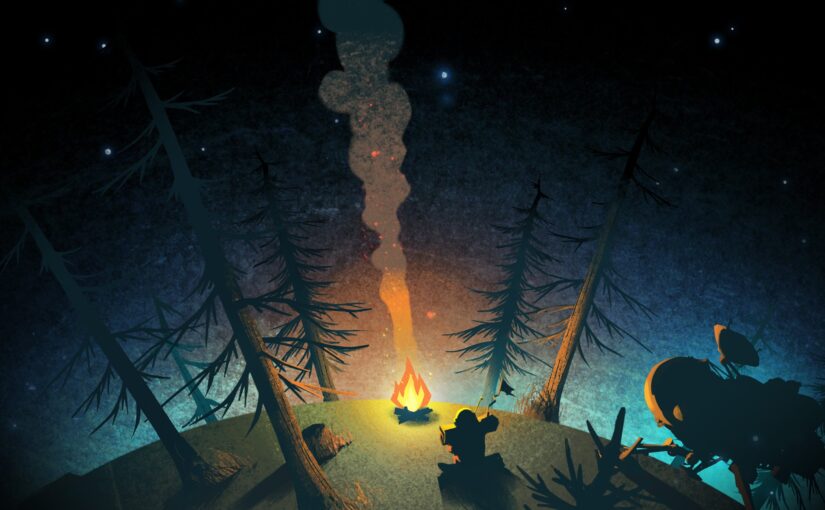
What was beautiful about playing the game on Twitch was the Outer Wilds fans coming out of the woodwork to watch the stream. None of them wanted to drop hints or spoilers. They just wanted to gather around the campfire, whistle an encouraging tune, and roast a couple of marshmallows—while they got to relive the game through someone else’s eyes. I want to do the same for you.

So, that’s it. That’s my review of the game.

I’ll only say this: I’m at a place in life where I’m trying to figure out what my next big exploration is—career, living arrangements, relationships, everything. I picked up the game with a sense of mild curiosity. I put it down awash in the bittersweet hope of new beginnings. This game reminded me that exploration is not an abandonment of the past. It’s a way of honoring it, while embracing a future that can’t be realized living in predictability and comfort. There are marvelous planets to visit, and they’re all within reach.

Play the game, if you feel ready to explore. When you do, I’ll be at the campfire waiting. And I’ll bring the marshmallows.