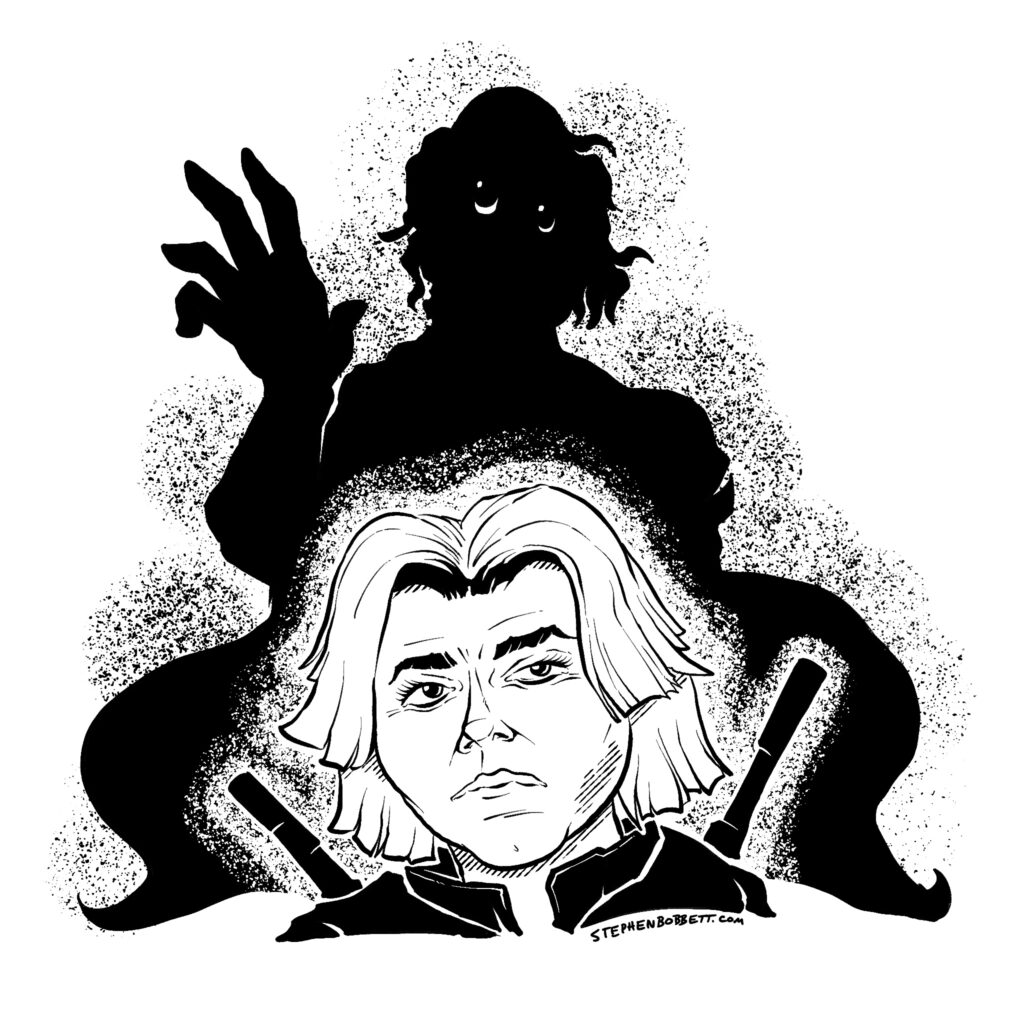
This month I’m drawing spooky, scary skeletons for the FancySchmancy Creature. This is the first, a skeleton tavern keeper requested by my Twitch mod Harukio. From here on out, I think we’re going to draw the skeletons of things that don’t usually have skeletons. It reminds me of seeing an octopus skeleton figure at a Spirit Halloween: biologically unfeasible, but seasonally awesome. More to come!
Of all the places to be seized by revelation, I didn’t expect it to be the Wash & Go Laundromat in Redondo Beach, California.
I’m on the West Coast for work, but also for reconnaissance. This past week, I’ve been trying to learn videography as rapidly as Neo learning kung fu. I’m attempting to give our company a healthy dose of modern digital marketing, filming the shoe wear testing process at our biomechanics lab in Los Angeles, and proving to our team we have the internal capacity for webinars, TikToks, and podcasting.
I’ve also been staying at a friend’s studio in the back of their house near Hermosa Beach, testing the waters of a move back to this side of the country.
I miss Southern California. Like, a lot. Yeah, the traffic sucks, and shit’s expensive, and the city sprawl is as thick as kudzu. But I have tried to replenish the word “home” in my brain with at least seven other states in the Union, and none of them fill it to the brim like this one does.
Last time I lived here was in 2008, right when the Great Recession was revving its engines. It was not a great time to be a college graduate in the City of Angels with only an inkling of a career path. I made the right choice at the time (that is, after a brief and impulsive move to the Pacific Northwest that led to a nervous breakdown, but I digress). I moved to the East Coast, where there was extended family and a semblance of stability. And for at least a decade, it remained the right choice.
But stability isn’t always growth, and historically, California is where I’ve come to grow. It’s where my first memories were forged, combing shells on Newport Beach as a little blonde-haired kindergartener when my family lived in Costa Mesa in the 80’s. It’s where I came back when I left home after high school in the Midwest. I got my bachelor’s degree in Azusa, had my first kiss in Pasadena, got hired for my first marketing gig in the Arts District. The decade or more I collectively spent in California was arduous sometimes, but it was nourishing, like how a shrub thrives in the desert.
And now, at the end of a long but fruitful week of shoe footage, I find myself doing laundry at the Wash & Go in Redondo Beach, getting ready to fly to a trade show in Portland. A song comes on the radio. It’s “Iris” by the Goo Goo Dolls.
This song. I think I first heard it when I was living in Indiana at 16, driving back and forth between home and my summer job as a kitchen manager at a youth camp. The last gasps of radio before MP3s nearly drowned it.
There’s a bit of trivia about this song that’s never left my brain’s disheveled archives. When it was written, the lead singer and songwriter John Rzeznik was suffering from a year-long case of writer’s block. Just when he thought his career might be withering, he got a call to produce a song for the movie City of Angels. And he determined that no matter what spilled onto the page, no matter what he felt about it, he would commit to it wholeheartedly.
He wrote the song in one day, like a primal scream. The song was so ubiquitous—and the word choices were so elementary—that it was easy to overlook the earnest tension on display in the chorus:
And I don’t want the world to see me‘ ‘Cause I don’t think that they’d understand When everything’s made to be broken I just want you to know who I am
In the music video, Rzeznik swivels on a chair in a lonely tower above the city, peering through a series of steampunk telescopes at a world he either can’t or won’t participate in. In the context of the lyrics, he’s a man torn in two: anchored to his isolation to protect what he perceives as grotesque injuries to his soul, but wanting to risk exposure to people so his soul might have a chance to flourish. It’s not unlike a songwriter in the throes of writer’s block, torn between latching his heart shut or opening it up to the world.
And it’s not unlike a single man with no kids at a transitional stage of his career, torn between the two coasts that, respectively, now offer the same prospects of stability or growth they always have in his past.
The song ends. The washing machine comes to a standstill. The clothes stop tumbling. An empty dryer awaits them.
It’s been a hot minute since I sat down and did an intense illustration like this. “Cuphead Noir” was originally drawn in the run-up to TwitchCon ’19, where I shared a booth in artist alley with my friend Ashley Villers. Of any video game fan art I’ve done, I think this is my favorite. I like how the composition and color scheme turned out, not to mention Cupheadis one of those games I could easily play once a year and get just as much satisfaction out of it as the first time.
I wasn’t a fan of Superman growing up. He was always a little boring to me. Every decision he made seemed to be the right one, and besides proximity to a glowing green rock, he had no natural weaknesses. Morally and physically, Superman’s strength always made the stakes feel too low for his stories to be truly heroic.
I gravitated more towards heroes like Batman: ones that were brooding and flawed. I liked that Batman walked a mental tightrope, barely hovering over the psychological precipice his villains would often willingly plunge themselves into. I liked his lack of superpowers, how his thinly armored mortality meant that his heroism required more risk. In the battle for my fandom, Batman often won, and Superman often lost.
That said, I always wanted to love Superman. I remember when the teaser for Zack Snyder’s Man of Steel first dropped—the swelling orchestrals, the bucolic scenes of a young Clark Kent—I thought we might get a movie about whether the world’s most famous do-gooder from the Second World War could exist in a 21st-century world of moral grey.
Unfortunately, Snyder’s answer to that question seemed to be: who cares? Sure, he gave us a couple of ham-fisted allusions to the Christ and a paint-by-numbers scene of our hero crying over having to murder of General Zod (which, to me, seemed to be a no-brainer given Zod was a genocidal maniac). But otherwise, there was no wrestling with the anachronism of Superman. If anything, the MCU took up that banner with their Captain America saga. But no such exploration for the man in red, blue, and gold.
For that reason, I was hopeful for James Gunn’s Superman. Gunn’s stories are usually about the exploits of barely reformed thieves and mercenaries, so a Boy Scout like Superman might seem like an odd fit. But Gunn knows how to find what makes comic book characters tick, and how to match that ticking to the beat of your own heart.
In Gunn’s film, I found a Superman I could root for—and who felt like he was rooting for me.
As an adult who’s a fraction less cynical than his teenage self, I’ve come to understand what Superman is, and I think James Gunn understands it, too. Superman is, at its heart, a thought experiment: in a world where power and cruelty often go hand-in-hand, what would it be like for the world’s most powerful man to be kind? It’s why Superman must be kind in his stories; otherwise, despite the laser vision and the freezing breath, there is nothing truly remarkable about him.
His rival Lex Luthor has power, too—in some ways more power, as his intelligence gives him an omniscience about the world that allows him to manipulate it in ways that Superman can’t. Lex tells himself that people’s reliance on Superman’s strength weakens them, a self-deceiving humanism that acts as a smokescreen for his solipsist view of the world. In truth, Lex isn’t jealous of Superman’s power but of his kindness, the actual quality that indicts Lex Luthor as just another unremarkable, power-hungry man.
There are so many things about this movie I could praise. The casting is flawless, especially with David Corenswet and Rachel Brosnahan. I could watch a two-hour stage play of their Clark and Lois, just dialoguing about their strange, budding relationship in a Metropolis studio apartment. I love the genuine Midwestern warmth of Ma and Pa Kent, the plucky grit of the Daily Planet staff, the disjointed foibles of the Justice Gang. I love how weird this movie is, how unabashedly it embraces the cosmic, surreal, and eclectic nature of comic books. I love how it promises a DC universe where many stories can be told and voices can be heard, without the MCU burden of sterile cinematography and tangled plots that clumsily weave between films.
But mostly I’m just glad that it gave us a Superman our pop culture has desperately needed for the past decade: one who recognizes that kindness is the most rapturous and radical way to wield power. James Gunn has given us a modern Superman we can now hold up to the Lex Luthors of the world and say: see, you bastards? This—this is how it’s done.
Martin Scorsese once described Marvel films as less than cinema and more like roller coasters. Even though I’m a fan of them, I tend to agree. Since the beginning with Iron Man, I’ve taken the time to watch them in theaters. When I do, I’m not looking for the complexity and depth of a Dostoevsky novel. I’m looking to sedate my brain for a couple of hours, popcorn and soda in hand, ready to just enjoy the ride.
But every once in a while, a Marvel property hits an emotional note with such earnest simplicity that it has to be more than just a theme park attraction. WandaVision gave us a portrait of mourning with a slice of poetry—“What is grief if not love persevering?”—that stayed etched on my heart years later. I refused to watch Guardians of the Galaxy Vol. 3 in public, knowing the story of a cyborg raccoon (of all things) confronting his core trauma was going to send me into a sobbing fit.
Who would’ve thought the next Marvel tearjerker would be Thunderbolts.
In truth, this movie was always going to be a sucker punch for me. I love ensemble stories that center on secondary or throwaway characters. And I love superhero movies with lower stakes than universe-ending catastrophes. This movie has the added juice of Florence Pugh and David Harbour reprising Yelena and the Red Guardian, whose debut shined in the otherwise unremarkable Black Widow movie.
But what this movie did better than almost any other Marvel property is pick a theme and knock it out of the park. From the start with Yelena practically sleepwalking off a building and bemusedly ambling through an adrenaline-fueled solo heist, this movie wants you to think about loneliness. The color palates are desaturated and monotone. The characters endure flashbacks to their most sequestered moments. The lead-up to the climax of the film has the Thunderbolts literally breaking through walls of their psychological torment to save each other.
But nowhere is this theme driven home harder than in Bob’s story. Him being absorbed by his alter ego the Void the more he tries to beat it senseless—and it receding only when Yelena and the others embrace him—caught my emotions off guard. I’m a sucker for an unconventional superhero climax in general, but this one really anchored itself in my head.
Melodramatic as it was, it’s the kind of blunt instrument I need sometimes, that community is the only remedy to isolation. Believe it or not, you can’t fight loneliness alone. It’s such an obvious statement to most people. But for me, it takes a superhero blockbuster to remember. I’ll take it.